Ancient Symposium is not a themed attraction assembled around anonymous objects. It grew from a family relationship with art—three generations of makers whose work, knowledge and influence meet in one space in Athens.
The gallery contains objects created by members of the family, but their presence is more than biographical. They explain why Ancient Symposium is built around participation. Art was not experienced in the family as something distant or untouchable. It was a process taking place nearby: material being shaped, ideas being tested and unfinished work gradually becoming complete.
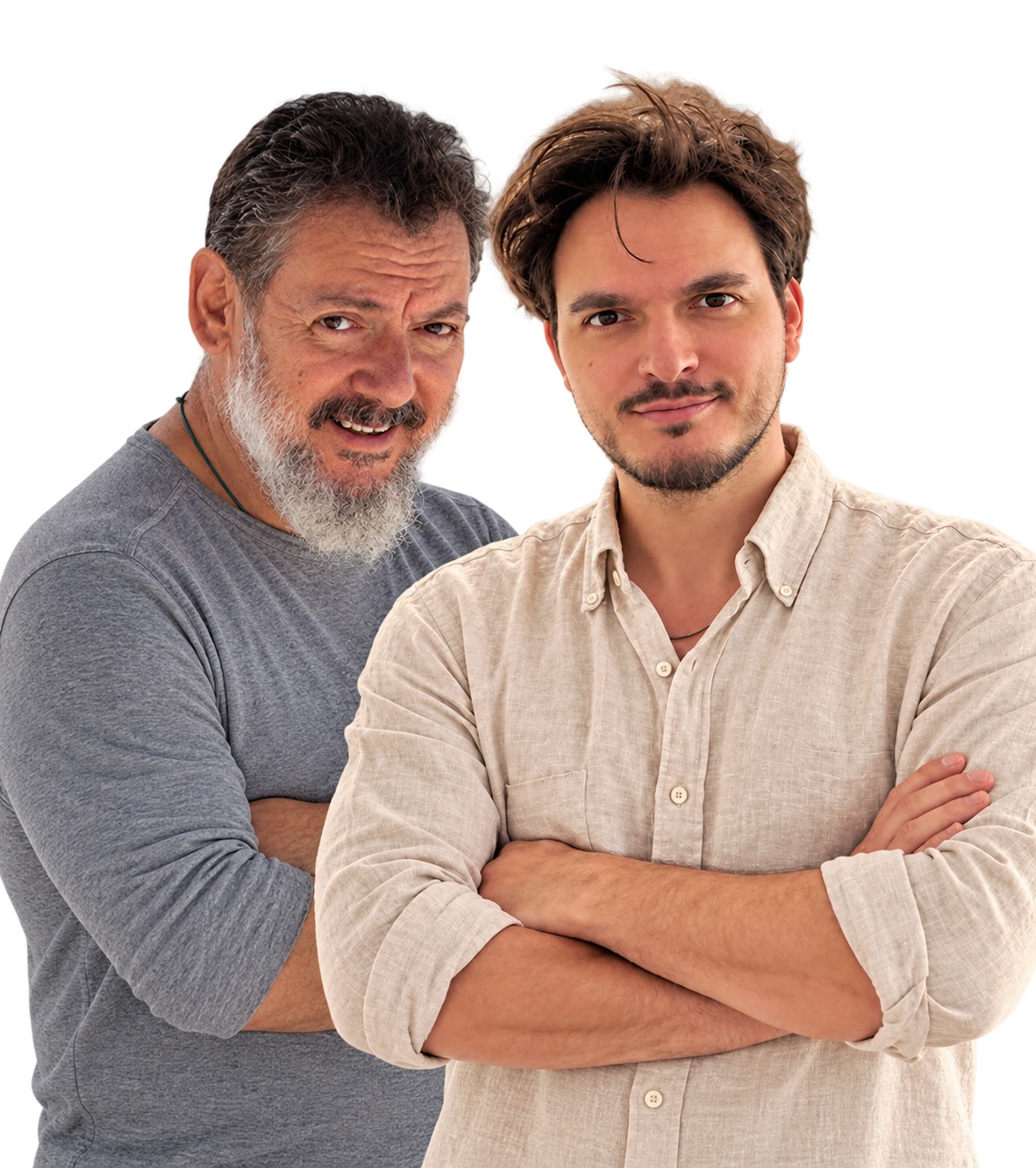
The First Creative Influence
Manos Roussis first encountered modelling while still very young. He made snakes, dinosaurs and imaginary forms from modelling dough, but the most important influence was his father, sculptor George Roussis.
Watching a face emerge from an ordinary piece of clay created a lasting impression. The transformation seemed extraordinary, as did the reaction of people who saw the completed work. That combination—the act of making and the emotion it produced—became the central reason to continue.
The wish was not only to preserve a talent across generations. It was to understand how the process worked, to practise it intensely and eventually to discover how it could be taught clearly to someone approaching clay for the first time.
Three Generations in the Gallery
The family story also includes painter Magda Roussi and a wider lineage of artistic practice. Works associated with three generations are displayed within the gallery, allowing visitors to see different materials, subjects and artistic perspectives in the same environment.
The space therefore functions as both a gallery and a living workshop. Finished objects are present, but so are tools, materials and active experiences. The visitor can move from looking at the result to understanding something about the act of creation.
Art, History and the Ancient Greek World
Ancient Greek history became a shared field where sculpture, objects, wine and storytelling could meet. Helmets, weapons, vessels, figures and architectural references are not included merely as decoration. Each gives the host an opportunity to explain why an object existed, how it was used and what it communicated.
Some works have also connected the family’s craftsmanship with international audiences, including creations associated with the visual world of Assassin’s Creed Odyssey and sculptural projects made for locations beyond Greece. These projects show how historical research and traditional making can speak through contemporary culture.
Why Create an Experiential Space?
A conventional gallery asks visitors to look. Ancient Symposium asks them to participate. The choice was deliberate: artistic knowledge becomes more memorable when it passes through the hands as well as the eyes.
A visitor may have already seen the Acropolis and the great museums of Athens. Those encounters are essential, but they cannot allow people to touch original objects or repeat historical processes. A hands-on cultural space offers the complementary experience: learning by making, tasting, smelling, comparing and asking questions.
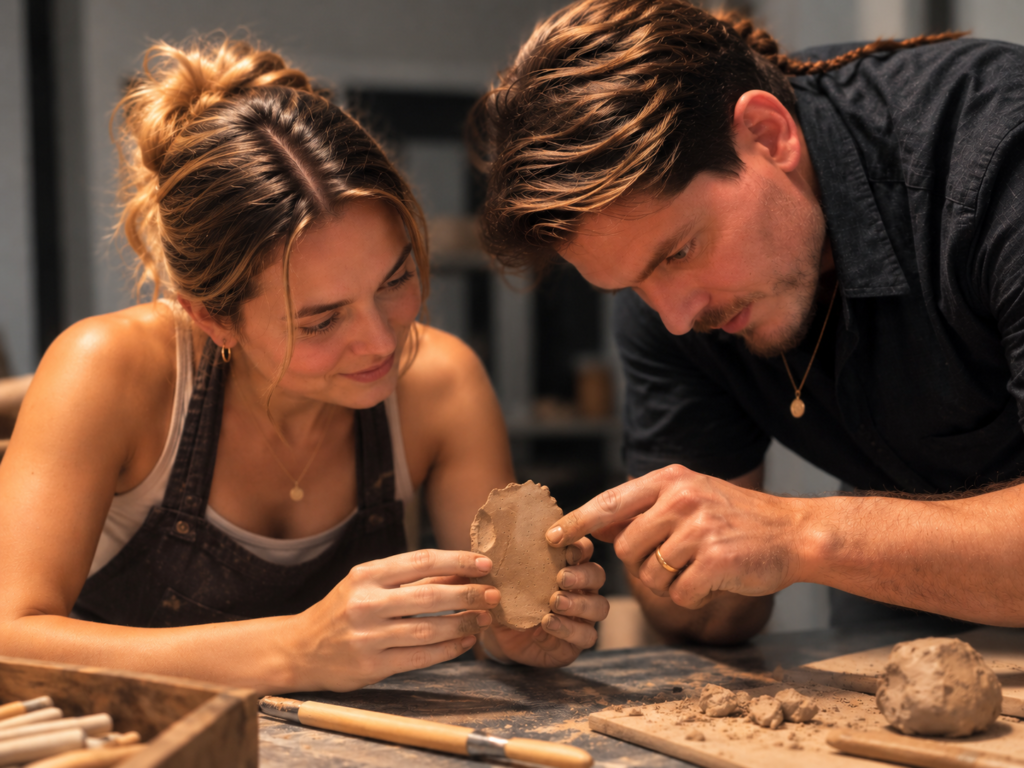
The Host as a Guide
The ambition is not for visitors simply to remember the name of their teacher. Manos wants to be remembered as someone who helped them discover a new route into creativity.
That may mean returning home with a clay face and a new hobby. It may mean looking at sculpture differently during the next museum visit. For another person, it may be the first sign of a deeper artistic direction. The result does not have to be the same for everyone.
A Place for Every Kind of Visitor
Ancient Symposium welcomes couples, families, solo travellers, groups of friends, schools and company teams. Knowledge does not belong to one age or one type of visitor, and creativity does not require a professional background.
Each group gains something different. A family shares a common memory. A solo traveller enters a conversation. A school group connects history with a practical activity. A team discovers how individuals approach the same challenge in different ways.
How the Space Should Feel
The venue is located in Kallithea on Syngrou Avenue, between the centre of Athens and the coast. It is close enough to become part of an Athens itinerary but removed from the busiest tourist environment.
When visitors descend the steps and enter, the aim is for them to feel that the outside city has changed. Sculptures, armour, vessels and unusual objects create immediate curiosity. The space begins telling its story before the formal experience has even started.
A Tradition That Remains Alive
Three generations of family art are connected not by repeating the same work, but by continuing the impulse to create. Ancient Symposium carries that tradition forward by opening it to visitors.
The central idea is simple: culture becomes part of you when you participate in it. The most meaningful souvenir is not only what you take home, but the knowledge that you were capable of making, understanding and seeing in a new way.