To understand wine in ancient Greece, it is not enough to study grape varieties or production techniques. Wine belonged to a wider cultural world: hospitality, ritual, conversation, music, games and the exchange of ideas. The symposium brought these elements together.
At Ancient Symposium in Athens, guests encounter wine through this broader story. The purpose is not simply to identify aromas and flavours. It is to understand how wine was made, stored, mixed, served and experienced—and why drinking together could become an organised social and intellectual occasion.
From Oenology to Ancient Greek Wine
Manos Roussis studied oenology for four years at the Technological Educational Institute of Athens, learning winemaking techniques used in Greece and around the world. After completing his studies, his long-standing interest in ancient Greek civilisation led him to investigate the place of wine in antiquity.
The subject proved far richer than expected. Historical research revealed extensive material about production, trade, regulation, storage and drinking customs. This led to a long-term ambition: to create a wine inspired as faithfully as possible by ancient Greek traditions, accompanied by a handmade bottle and presentation case that would make the history visible as well as tasteable.
Wine and sculpture may appear to belong to different worlds, yet both require knowledge, patience and personal judgement. A sculptor shapes material into form; a winemaker guides fruit through transformation. In both cases, technique and creativity determine the final character.
What Was an Ancient Greek Symposium?
The Greek word symposium refers to drinking together, but the gathering was more structured than a modern party. Participants reclined on couches arranged around the room. Wine was shared, entertainment could be offered and games could be played, but discussion was often central.
A subject might be chosen—love, beauty, courage or another question—and each participant was expected to contribute an idea without merely repeating the previous speaker. The format encouraged attention, memory and invention. Wine accompanied the conversation, but it was not meant to destroy it.
Why Was Wine Mixed with Water?
Ancient Greeks commonly mixed wine with water in a krater before serving it. The exact proportion could vary, but the cultural principle was moderation. The gathering sought a balance between Dionysian enjoyment and Apollonian order: pleasure without the loss of reason and companionship without chaos.
Excessive drunkenness was frequently treated as undignified or barbaric. Dilution allowed the symposium to last while participants continued to speak, listen and take part. Wine became a social medium rather than an end in itself.
The Kylix: A Cup Designed for the Symposium
The kylix was a wide, shallow drinking vessel with two horizontal handles. Its broad opening brought the drinker’s face close to the wine, allowing its aromas to be experienced with every sip.
Its shape also suited a reclining position. A participant could hold a handle securely while resting on a couch. Elegant, practical and connected with games such as kottabos, the vessel shows how design reflected the behaviour of the symposium.
Wine, Trade and Authenticity
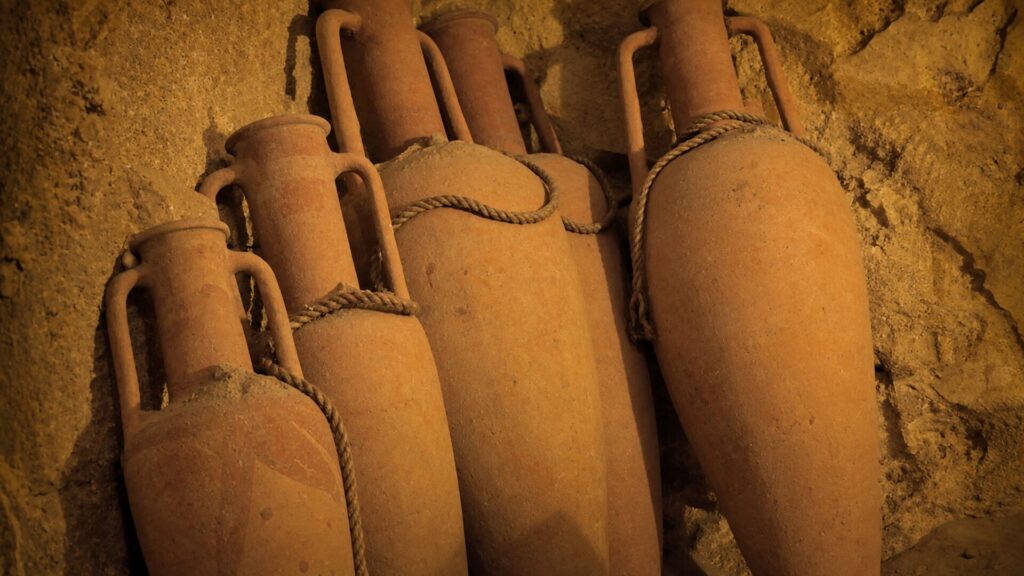
Greek wines were traded widely in antiquity. Amphora shapes, stamps and other marks could communicate origin and identity, while regulations sought to protect products and commerce. The history of wine therefore includes early forms of branding, taxation and concern for authenticity.
For a modern visitor, this is an important reminder: wine was not a minor detail of ancient life. It was an agricultural product, an export, a ritual substance and a source of social meaning.
A Tasting That Goes Beyond the Glass
The experience uses contemporary Greek wines to open a conversation about the ancient world. Varieties such as Agiorgitiko connect naturally with Nemea, a region whose wine identity reaches far into Greek history, while Malagouzia introduces a fresh and aromatic expression of modern Greek winemaking.
Visitors drink from vessels inspired by ancient forms, explore the room and its objects, and learn how wine belonged to the rhythm of a symposium. They may recline, sit on a throne inspired by ancient design and experience the story spatially rather than through a lecture alone.
Many guests say that they do not want to leave the room. The atmosphere slows the pace of the visit and creates a contrast with the busy city outside. That feeling—knowledge combined with relaxation and participation—is at the heart of the experience.