“I have never touched clay before.” “I am not artistic.” “Mine will never look like a face.” These are some of the most common things guests say at the beginning of a sculpture workshop. Two hours later, they are usually looking at a figure they created themselves—and wondering why they waited so long to try.
At Ancient Symposium in Athens, sculpture is not presented as a skill reserved for professionals. It is approached as a language that can be learned step by step. The aim is not to copy a perfect museum object, but to understand how a face is built, how proportions work and how a simple piece of clay can gradually acquire expression and character.
A Childhood Surrounded by Art
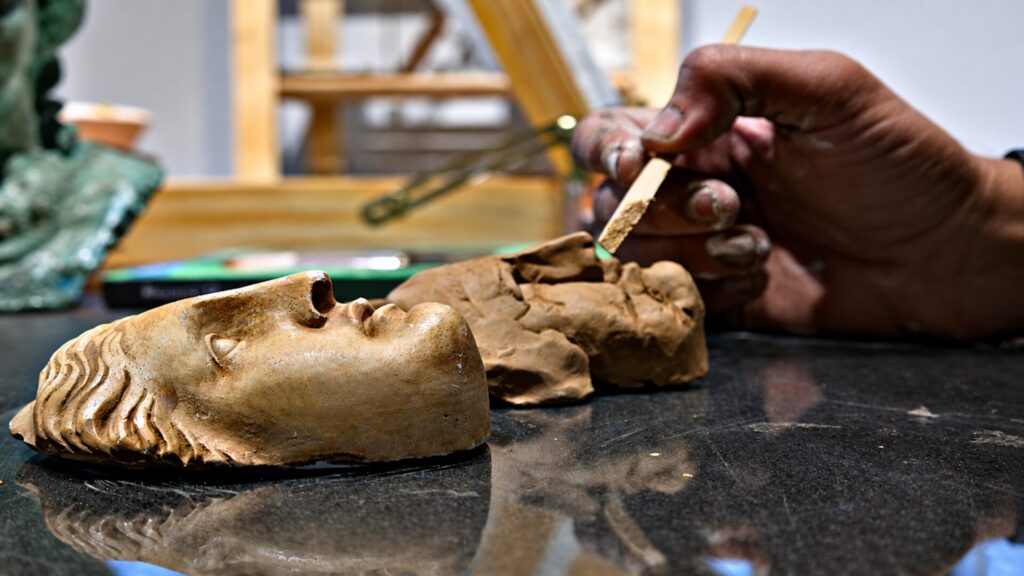
For sculptor Manos Roussis, the relationship with modelling began in childhood. Before clay, there was modelling dough: snakes, dinosaurs and small figures shaped by hand. The decisive influence, however, was watching his father create. A shapeless piece of clay could become a face, and that transformation seemed almost impossible.
The reactions of other people were equally powerful. They were surprised that something so expressive could emerge from such a simple material. That response created a determination to continue a family ability rather than allow it to disappear. Through persistent experimentation, observation and practice, sculpture became both a profession and a way of sharing creativity with others.
Why Hermes?
The workshop focuses on a face inspired by Hermes. The celebrated statue known as Hermes and the Infant Dionysus, traditionally attributed to Praxiteles and displayed at the Archaeological Museum of Olympia, is one of the most admired works associated with ancient Greek sculpture.
Hermes also carries a fitting meaning for an experience in Athens: he was the protector of travellers. Guests who have journeyed to Greece create an object connected with the god who accompanied movement, exchange and discovery. His distinctive features also make him an excellent subject for learning facial construction.
The subject may evolve in future workshops. Athena, Medusa and other figures from Greek mythology offer different expressions and stories. What remains constant is the connection between the person being sculpted, the cultural meaning behind the figure and the visitor’s own creative process.
Building Rather Than Carving
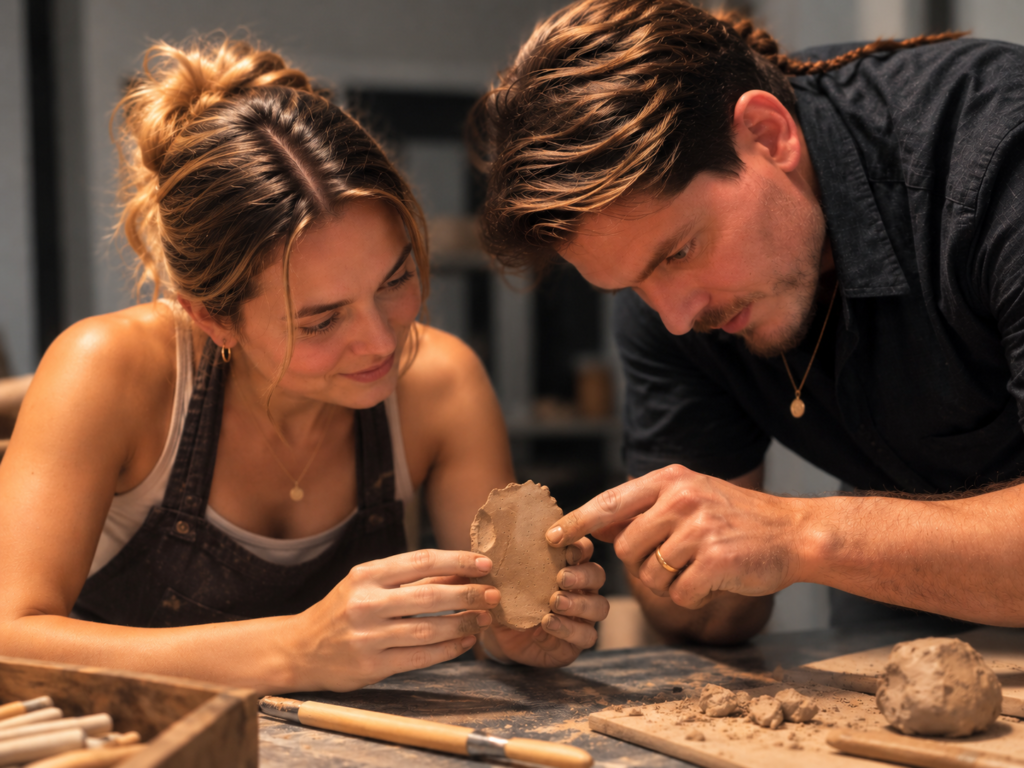
Many beginners imagine sculpture as the act of carving into a solid cube until a figure appears. Working with clay can follow the opposite direction. Participants build the face by adding material. Forms are developed gradually and adjusted through observation, measurement and small corrections.
The workshop introduces proportion, volume, depth and the relationships between facial features without revealing the studio’s proprietary teaching method. Specially made tools and careful hand-finishing support the process, but the essential ingredient is attention: looking closely, comparing and learning how one change affects the whole face.
From Laughter to Concentration
Early in the process, temporary shapes can create unexpected and amusing expressions. This is often one of the happiest parts of the workshop. People laugh with one another, become less afraid of making mistakes and begin to experiment.
As the face develops, the atmosphere changes. Participants become focused and calm. They start noticing details that they would previously have overlooked. When they ask for help, the guidance is designed to move their work forward while keeping it recognisably their own.
The final reaction is usually not only pride in the object. It is surprise at what they were able to do. Some previous guests have continued making art after the experience because the workshop revealed an ability they had never been given the opportunity to explore.
Creativity Is Not Limited to One Kind of Body
One particularly moving participant joined the workshop without fingers. Through determination, adaptability and close guidance, he created his own distinctive face. The experience was a reminder that artistic participation should not be defined by a conventional image of the artist.
Every person works differently. The purpose of teaching is to help the participant find a practical route into the material, not to judge whether they fit a predetermined category of talent.
What Do You Take Home?
At the end of the workshop, guests leave with the face they created, but also with knowledge: how form grows, why proportions matter and how patient observation can turn uncertainty into a finished result. The object becomes a personal souvenir of Athens because it records something the visitor actually did.
If you believe you are “not an artistic person,” the honest answer is that you may not know yet. Creativity often needs an opportunity before it can be recognised.